Under the main theme “Today’s research for tomorrow’s value creation”, the German Federal Ministry of Research, Technology and Space (BMFTR) hosted the Days of Digital Technologies (Tage der digitalen Technologien, TddT) in Berlin on November 9th and 10th, 2026. The 6G transfer hub 6GEM+ was represented with exhibits from Ruhr University Bochum and RWTH Aachen University, as well as with PANGOLIN Networks, the 6G startup project of TU Dortmund University.
The Days of Digital Technologies brought together research, industry, startups and policymakers to show how key digital technologies are translated into economic value. Alongside expert forums on topics such as technology transfer, the circular economy and cybersecurity, as well as themed guided tours, the event centered on an interactive exhibition of demonstrators from BMFTR-funded projects.
A highlight was the panel with Federal Minister Dorothee Bär and representatives of the startup scene, focusing on how research results can be turned into new ventures and market-ready products.
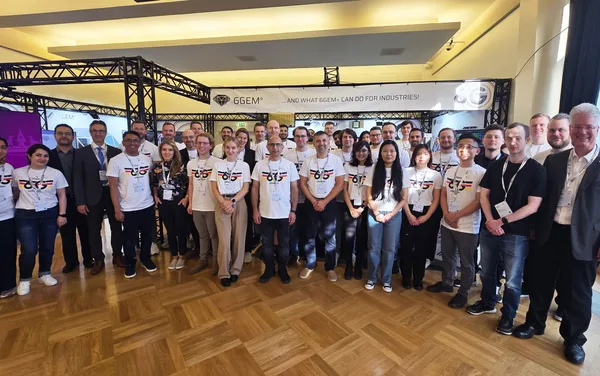
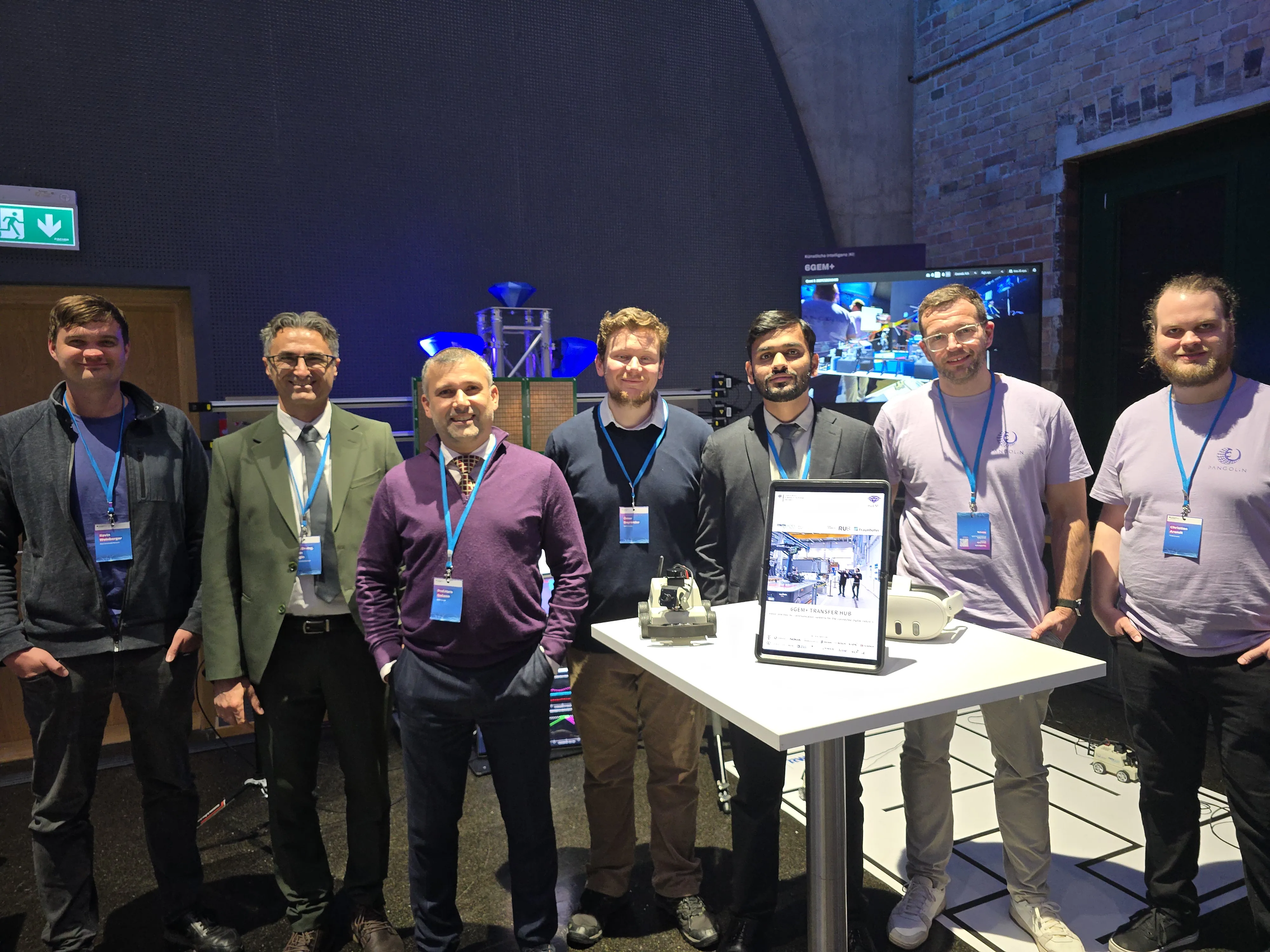
6GEM+ presents latest 6G research results. At the 6GEM+ booth, visitors experienced first-hand how 6G research enables concrete industrial applications. Ruhr University Bochum and RWTH Aachen University presented two demonstrators.
RWTH Aachen University showcased its Physical AI platform, integrating advanced AI methods for the control and optimization of digital industry. The demonstrator introduced an innovative concept of immersive and interactive industrial digitalization, bringing together AI, connectivity and intelligent control. Visitors had the opportunity to interact directly with the platform and experience how AI-enabled technologies can transform future production environments and innovative mobility. The strong interest and engagement highlighted the growing relevance of Physical AI in shaping the next generation of intelligent, connected and autonomous industrial systems.
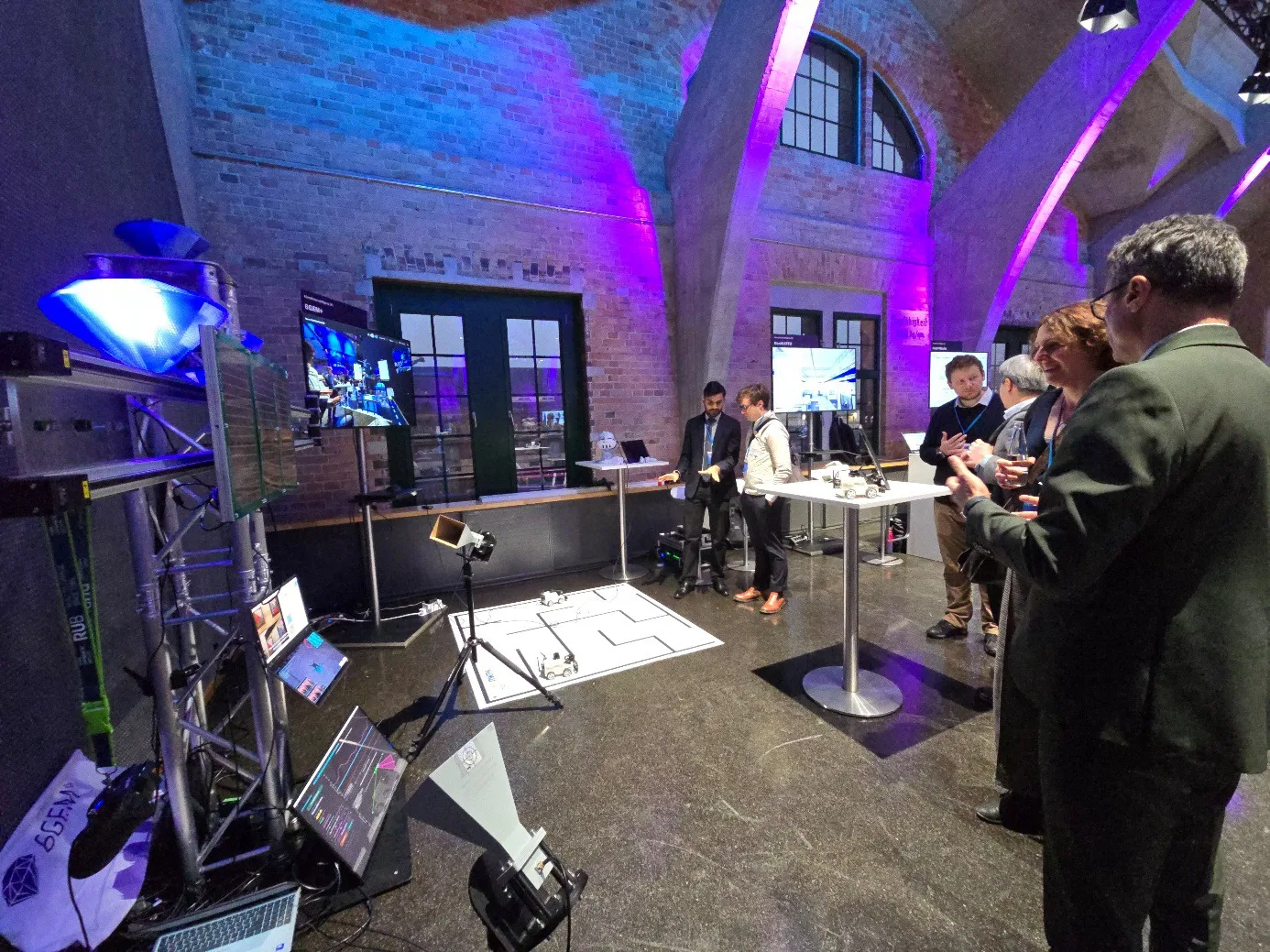
The second exhibit shows how a drone carrying a Reconfigurable Intelligent Surface (RIS) can restore wireless connectivity in disaster scenarios, where damaged or overloaded infrastructure often cuts first responders off from the network. In the setup, horn antennas stand in for transmitters and receivers, and a motorized rail moves the RIS to emulate the drone’s flight. The RIS reflects and redirects signals to keep links alive between them. A digital twin models what makes this hard in practice, such as wind gusts, drone vibration and the need to reconfigure the RIS continuously while the drone moves. The drone can be steered by model-based or AI-driven methods that rely on local information. Alongside it, the digital twin keeps predicting signal quality along the planned paths and supplies side information that points to better alternatives. A live monitor shows the benefits through key performance indicators such as received signal strength and shows how the design stays resilient when conditions change. More broadly, the demonstrator illustrates how communication can support physical AI: autonomous systems acting in the real world depend on reliable connectivity and timely information to make sound decisions.
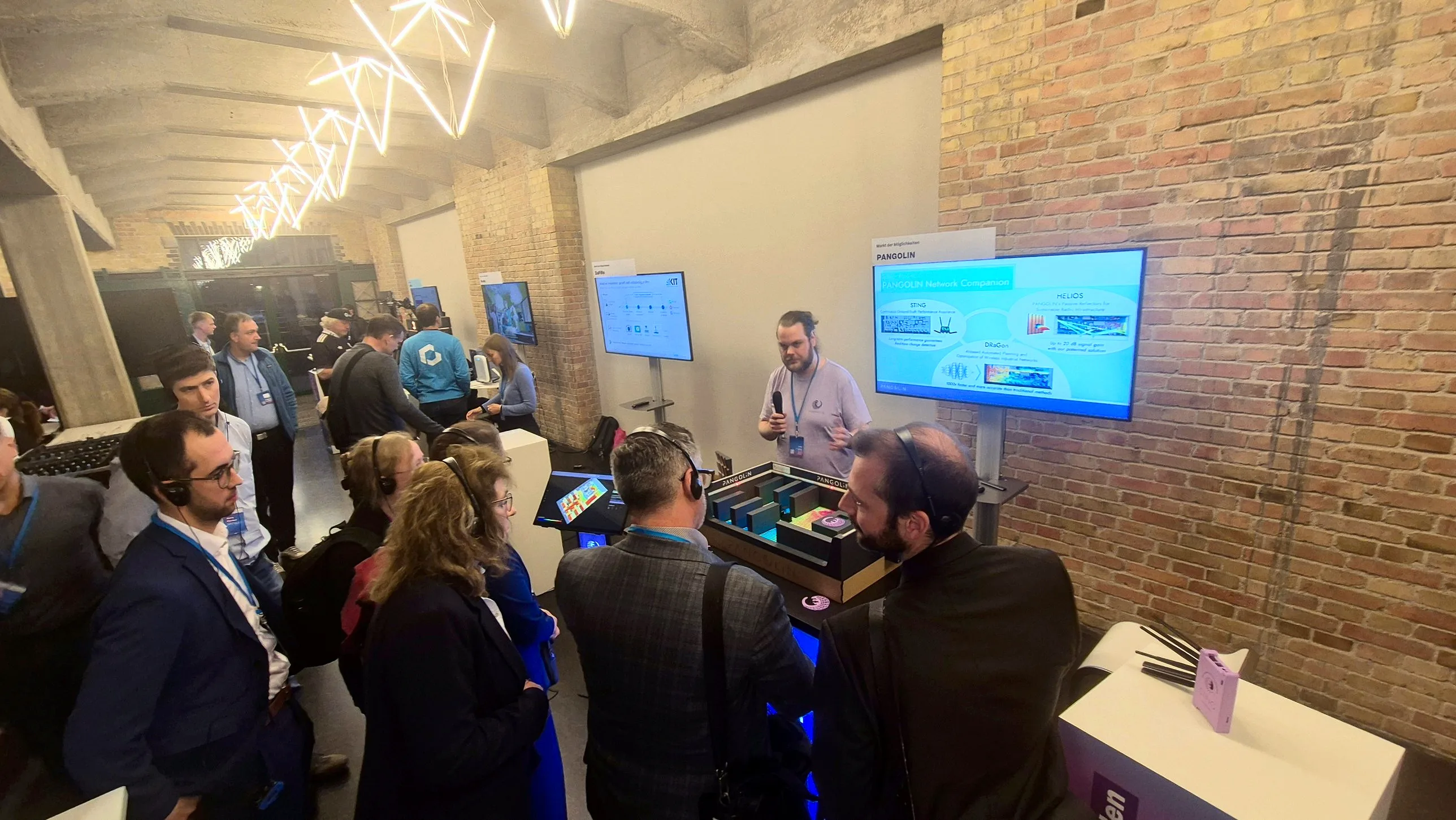
PANGOLIN Networks showcased industrial 6G networks interactively. Funded under the StartUpConnect program, the spin-off project of the Chair of Communication Networks at TU Dortmund University is developing the PANGOLIN Network Companion, an integrated solution for planning, assessing and optimizing industrial wireless networks. It combines three building blocks: STING measures the actual quality of service from the application’s perspective, DRaGoN uses AI for radio coverage prediction and network planning up to 1,000 times faster than conventional approaches, and HELIOS improves coverage with patented passive reflectors made by 3D printing, which supply shadowed areas with gains of up to 20 dB without any additional power consumption.
In the interactive demonstrator, visitors designed their own production scenario by placing objects in a scaled 3D industrial hall. The system detects these changes, updates the 6G connectivity map using AI and, if necessary, replans an efficient and sustainable cross-frequency network. It also makes visible how passive HELIOS reflectors enhance coverage without requiring additional active hardware.
The Days of Digital Technologies provided an ideal stage to present the results of 6GEM+ to a broad audience from politics, industry and academia. We would like to thank the BMFTR for the invitation and all visitors for the many inspiring conversations at our booths.
More information: pangolin-networks.de | bmftr.bund.de